
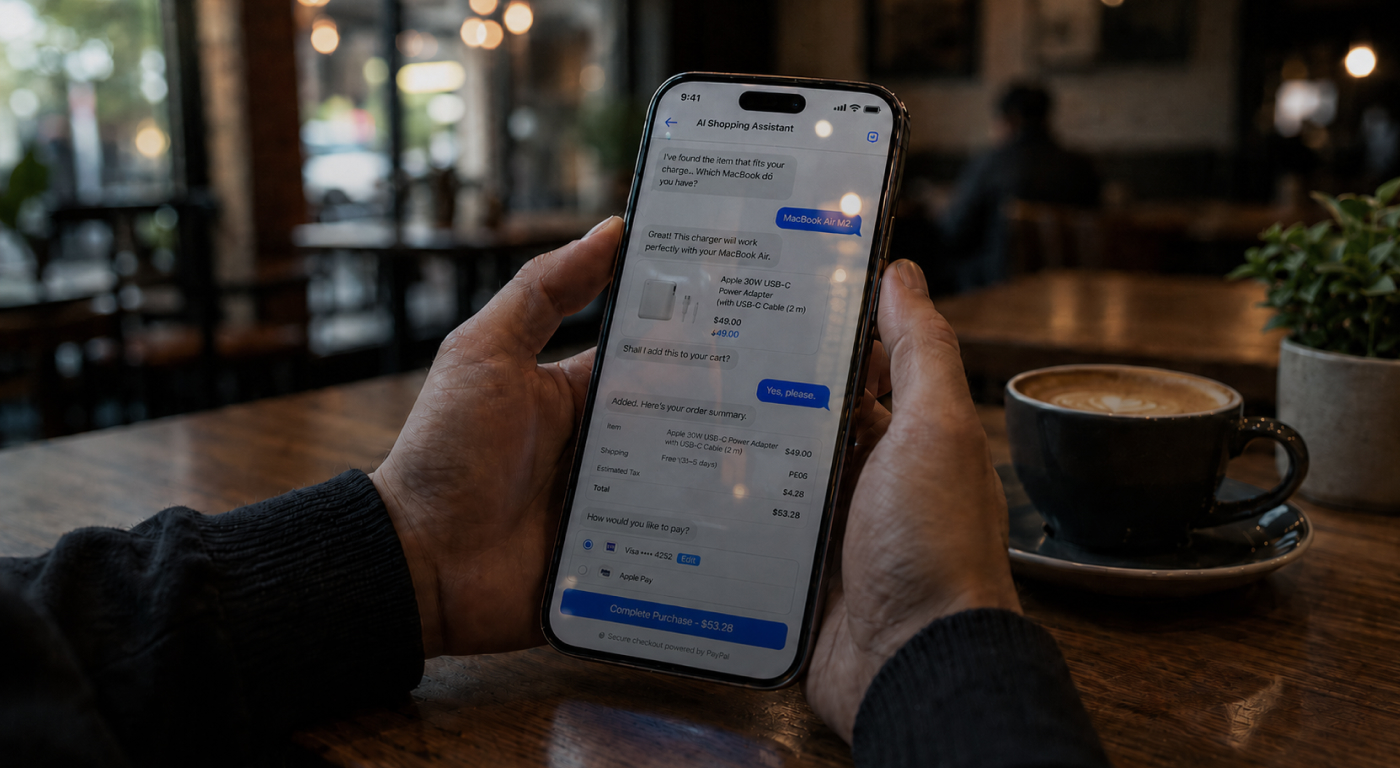

Agentic commerce is the moment AI stops recommending products and starts buying them. ChatGPT can already complete a purchase inside a conversation, Google's new Universal Cart turns Search, Gemini, YouTube, and Gmail into one shared shopping surface, and PayPal's agentic checkout is the payment layer underneath it all. Here is what merchants need to understand, and how to prepare your store now.
What Is Agentic Commerce?
Agentic commerce is online shopping where an AI agent, not a human, completes the purchase. The shopper still chooses what they want, but the agent handles the search, the comparison, the cart, and the checkout on their behalf. The merchant interacts with the agent, not the buyer.
This is a real shift from the recommendation era. For years, AI helped people find products and then handed them off to a website to finish the job. Agentic commerce removes the handoff. The agent stays in the conversation, sees your catalog, places the order, and reports back to the shopper when it is done.
A run of launches between late 2025 and Google I/O 2026 turned this from a research demo into a live channel:
- ChatGPT Instant Checkout: OpenAI now lets U.S. users buy directly inside ChatGPT, starting with Etsy sellers and expanding to more merchants through 2026. No tab switch, no checkout page.
- The Agentic Commerce Protocol (ACP): Stripe and OpenAI open-sourced a shared specification so any AI agent can talk to any merchant in a standard way. ACP powers ChatGPT's checkout flow.
- AP2 (Agent Payments Protocol): Google and PayPal, joined by Mastercard, American Express, Coinbase, and more than sixty partners, launched a standard built around verifiable payment authorizations. This is the payment layer of the Google stack.
- Universal Commerce Protocol (UCP): Google announced UCP at NRF in January 2026 and expanded it at Google I/O in May 2026. UCP is the commerce-and-checkout layer that sits on top of AP2, with major retailers including Amazon and Walmart among the launch partners.
- Universal Cart: Also announced at Google I/O 2026, Universal Cart is a single shared shopping cart that lives across Google Search (AI Mode), the Gemini app, YouTube, and Gmail. A shopper can add a product from any of those surfaces and let the agent finish the purchase.
Together, these mean agentic commerce is no longer hypothetical. The rails are being installed across the payments and search ecosystems right now.
Why This Matters for Your Store
The short version: a new sales channel is being built on top of conversational AI and search, and the merchants who are reachable through it first will be the ones AI agents surface first.
A few specific shifts are worth thinking about:
- Discovery is changing: Shoppers ask an agent for "the best pour-over coffee maker under $80" instead of searching Google and clicking ads. The agent picks what to surface based on structured product data, not SEO rankings.
- Checkout is moving: When an agent completes the purchase inside ChatGPT or inside Google's Universal Cart, your storefront is no longer the last touchpoint. Branding, upsells, and post-purchase flows all need to adapt.
- Trust signals shift: Reviews, return policies, and shipping clarity matter more, because the agent reads them on the buyer's behalf and uses them to make the call.
- New data, new questions: You will see orders coming from agents instead of human sessions. Attribution, fraud screening, and customer service all need an answer for "who is the customer when the AI placed the order?"
None of this replaces your existing storefront. It adds a channel alongside it, much the same way mobile commerce did fifteen years ago. The merchants who treated mobile as a curiosity then are mostly gone now.
The Protocol Landscape (and Why You Do Not Have to Pick a Side)
There are three open standards in play, and they line up into two parallel tracks. Here is the plain-English version.
Track 1: ACP (Stripe + OpenAI)
The Agentic Commerce Protocol defines how an AI agent requests product info, builds a cart, and triggers a payment using a Shared Payment Token. ACP is what powers ChatGPT Instant Checkout today. If a buyer asks ChatGPT to order something, ACP is the wire format under the hood.
PayPal is one of the payment options on this track. In October 2025, PayPal announced it is adopting ACP to power Instant Checkout inside ChatGPT, with merchant rollout beginning in 2026. PayPal operates an ACP server that handles merchant routing and payments behind the scenes, so merchants who have PayPal enabled do not need to build a direct ACP integration to be reachable through ChatGPT.
Track 2: UCP on top of AP2 (Google + PayPal)
The Google stack is two layers that fit together.
AP2 (Agent Payments Protocol) is the payment layer. It focuses on cryptographically verifiable mandates, which are signed instructions that prove the shopper actually authorized the agent to spend up to a certain amount, on certain items, under certain conditions. AP2 works across cards, bank rails, stablecoins, and digital wallets, with PayPal as the primary launch partner.
UCP (Universal Commerce Protocol) is the commerce layer. It defines how an AI agent reads your catalog, builds a checkout session, and completes the order. UCP is what powers checkout inside Google's AI surfaces, including Universal Cart, AI Mode in Search, and the Gemini app. UCP is explicitly designed to use AP2 underneath for the payment step, which means PayPal's agentic checkout is the on-ramp for the Google stack as a whole.
UCP went live in Google Merchant Center in January 2026 and is rolling out to Canada, Australia, and the UK over the coming months, with YouTube checkout next.
What This Means for Merchants
Most merchants do not need to choose between the tracks. The protocols solve overlapping problems and the major payments players are signaling support for both. PayPal is the clearest example: it is the AP2 launch partner on the Google track, and it has also adopted ACP for ChatGPT Instant Checkout. One payment partner, both rails. What matters is making sure your store is reachable through whichever standard the agent on the other end happens to speak. That is a platform-level concern, not a merchant-level one, which is the next point.
How to Prepare Your Store for Agentic Commerce
You do not need to build a protocol implementation to participate. You do need to make sure the data, payment, and policy layers of your store are in shape for an agent to read. Here is the practical checklist.
1. Clean Up Your Product Data
Agents read structured product information the same way they read documentation. Vague titles, missing attributes, and inconsistent variant names all hurt your visibility inside an agent's results. Use clear, descriptive product names. Fill in attributes like size, color, material, and weight. Write benefit-led descriptions in plain language. The same hygiene that helps Google Shopping helps an AI agent. If you already feed Google Merchant Center for Shopping ads, you have a head start, because UCP reads from the same product feed.
2. Make Inventory and Pricing Truthful in Real Time
Agents will not tolerate the "checkout surprise" pattern, where a shopper adds something to the cart and only then learns it is out of stock or the price has changed. Real-time inventory and accurate pricing are a baseline requirement. If your stock data is stale, the agent will either complete a sale you cannot fulfill or, worse, stop trusting your catalog.
3. Make Shipping and Return Policies Machine-Readable
Buyers ask agents questions like "will this arrive before Friday?" and "can I return it if it does not fit?" The agent needs to find that answer in your store data, not in a marketing PDF. Plain-text shipping rules, posted return windows, and clear delivery estimates all matter. So does correct tax behavior at the cart level.
4. Enable an Agent-Ready Payment Path
This is the part most merchants cannot solve on their own, because it requires your platform to speak one of the new protocols. The good news is that the payments providers are doing most of the work. PayPal supports both standards: AP2 on the Google side and ACP on the ChatGPT side. That capability is available to UltraCart merchants today through the platform's PayPal agentic commerce integration. One payment partner reaches both sets of agentic surfaces, which is the cleanest path through the current protocol mess.
5. Plan for Post-Purchase Outside Your Site
If the agent completes the order inside its own interface, the shopper may never visit your storefront for that transaction. That makes order confirmation emails, shipping updates, and customer service touchpoints more important, not less. They are now your main brand surface for that order. Make them count.
What About Fraud and Returns?
Two questions come up in every merchant conversation about agentic commerce, and they deserve direct answers.
Fraud risk: Agentic payments use authorization tokens that are scoped to a specific purchase, with a verifiable record that the shopper consented. In practice this is closer to a wallet purchase than a card-not-present transaction, and early data from the launch partners suggests fraud rates are lower than traditional checkout, not higher. Your existing fraud rules still apply, and you keep the right to decline.
Returns and disputes: The shopper is still the customer of record. Your normal return policy applies. The agent simply acted as a buying assistant, the same way a personal shopper or a procurement system does. The merchant remains the merchant of record in both ACP and UCP flows, which means you keep ownership of the customer relationship and the post-purchase experience. If anything, the structured order data makes returns easier to process, because the original intent is recorded.
The Honest Timeline
Agentic commerce is real today but it is not yet a meaningful share of orders for most stores. ChatGPT Instant Checkout is limited to certain merchants and product types. Google's UCP-powered checkout is live in the U.S. and rolling out to Canada, Australia, the UK, and YouTube over the next several months. The total dollar volume is still small.
The reason to pay attention now is not the immediate revenue. It is that the rails are being built right now, and the merchants whose catalogs, payment integrations, and product data are ready will be the ones agents surface first as adoption grows. This is roughly where mobile commerce was in 2010. Quiet, growing, easy to dismiss, and impossible to ignore three years later.
How UltraCart Fits In
UltraCart's approach to agentic commerce is the same as its approach to every other channel: build the integration into the platform so merchants do not have to manage it themselves.
That means the PayPal agentic commerce integration is built in, not a bolted-on app. Your existing catalog, inventory, and tax setup work as-is. Your analytics capture agent-driven orders alongside the rest of your traffic. Your API and webhooks fire on agentic orders the same way they fire on storefront orders, so your downstream systems do not need changes.
Because PayPal supports both ACP (the ChatGPT side) and AP2 (the Google side as a launch payment partner for UCP-powered checkout), the same PayPal integration reaches both sets of agentic surfaces. One integration, both rails. If you are building or refining your catalog for AI agents, the same work pays off across your hosted storefronts, marketplaces, and any future agent channel. Built-in beats bolted-on every time, because every channel reads the same product data and routes through the same checkout logic.
What to Do This Quarter to Get Ready for Agentic Commerce
If you do nothing else from this article, do these four things in the next ninety days:
- Audit your top 100 SKUs for title clarity, attribute completeness, and description quality. Make sure your Google Merchant Center feed is current, because that is what UCP reads.
- Confirm your inventory and pricing feeds update in real time.
- Post clear, machine-readable shipping and return policies on every product and checkout page.
- Turn on PayPal agentic commerce so your store is reachable when shoppers buy through ChatGPT today and through Google's Universal Cart as it rolls out.
That puts you ahead of the curve when adoption picks up, without betting the business on a channel that is still maturing.
Ready to Connect Your Store to Agentic Commerce?
UltraCart's PayPal agentic commerce integration turns on agentic checkout for your store with the catalog, payments, and order management you already have. It is the AP2-based payment layer that powers PayPal's agentic flow today and the same one Google's Universal Commerce Protocol uses underneath. No protocol engineering, no separate stack, no rebuild. Take a look at how it works and what it takes to enable it for your store.